Posts

Showing posts with the label Copper alloy
We're back for our 12th season. Keep up to date with all the discoveries, brought to you by our daily bloggers.

Day 8 and things are really hotting up on site…
Image
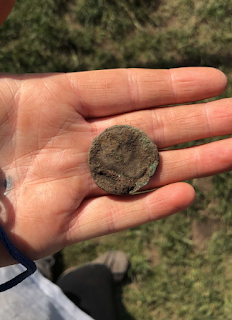
Abigail’s group make a nice find in trench 4… Today we continued to dig down into the next context alongside the Roman road. Upon doing so we discovered a range of Roman pottery, building materials and animal bone. The discovery of a copper alloy Roman coin by Kayleigh was also a highlight. A copper alloy coin dating to the Roman period. Keep an eye out for more info towards the end of the dig! Alfie’s group find a big cat… Today Group C’s main job was using tools such as the mattocks, shovels and hand trowels to slowly work down the section in the supposed Anglo-Saxon ditch whilst occasionally cleaning it to see if there were any changes in the soil’s context. The main kinds of contexts we worked through today were mixed clay soils and a grey silty deposit. In terms of finds, many sherds of pottery, including samian ware and black burnished ware, were found along with ceramic building material all dating to the Roman period. Lots of animal bones were found as well. Mos...

Julie gives us a wonderful overview of the post-Roman finds from this year's excavations...

Image
After a bit of a slow start quite a large assemblage of finds has been retrieved over the last 3 and a half weeks and predictably this week the excavation of part of a ditch running north/south across the site is producing bags and bags of animal bone and pottery. Last year’s backfill produced an amazing range of finds: clay tobacco pipes, lead shot, fragments of Samian pottery, as well as Westerwald stoneware and post-medieval Spanish olive jar and a variety of other post-medieval wares, including slipware dish fragments, blackware vessels and pieces of Cistercian ware cups. It’s interesting to see what ended up on last year’s spoil heap rather than in finds trays but it is easy to miss fragments when it’s wet and muddy. Once the backfill had been removed the quantity of clay tobacco pipes found fell considerably and stopped completely after the last of the 17th century demolition deposits were removed from the south side of the trench. It looks as if we are firmly in the 16th ce...

The building emerges

Image
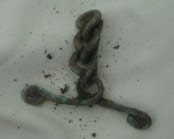
Mark starts us off early on Monday morning - Now that a good deal of the compacted overburden has been prized from between the gaps in the 17th c. rubble surface, it is much easier to envisage the footprint of the building previously mentioned by Heidi. Regularly occuring padstones on which timber posts may have sat protrude over the surrounding building debris. These padstones do not appear to be of homogenous manufacture. One appears to be made of a series of mortared Tudor-style bricks indicating that materials from an older building was used, and this structure may have been a service or lower status wing rather than a mansion hall (if at all associated with Cholmondley's Hall). A medieval green glaze sherd was also found in this level. Metallic artefacts have not been abundant at the dig as yet, but an interesting copper alloy chain and attached "T" bar (see pic - possibly part of a suspension mechanism, size approximately 30mm x 30 mm), was found centrally within th...